Sunday, July 9, 2023

Sermon: Getting It Wrong

First Presbyterian Church

July 9, 2023, Pentecost 6A

Psalm 119:169-176; Romans 7:14-25


Getting It Wrong


Before plunging into Paul's latest bit of pondering, it's worth a stop in the longest chapter in the Bible, which (perhaps not surprisingly) comes from the longest book of the Bible. 

Psalm 119 is an acrostic poem, with each section beginning with a corresponding letter of the Hebrew alphabet; this means twenty-two sections in all, each consisting of eight verses as our modern arrangement of scripture divides it (if you read along in your pew Bible you saw this structure as it appears in print). Into this extended poetic structure the author has poured what one scholar calls "the exaltation of Torah," most likely a reference to those first five books of Hebrew scripture typically regarded as the law in Hebrew usage.[1] Across these twenty-two stanzas the poet has indeed exalted the Torah, spinning out verses in praise of that law despite whatever sufferings or persecutions the author might experience. The first seven verses of today's reading are relatively typical of the substance of the larger psalm.

But then, what happens in the eighth verse of this reading, the very last verse of this "exaltation of Torah"? For the first time in this extended psalm the author acknowledges "I have strayed like a lost sheep. Seek your servant, for I have not forgotten your commandments.

Notice that the author doesn't claim to have forgotten the law; in fact the author very specifically says "have not forgotten your commandments"; nonetheless the author has gone astray "like a lost sheep." No matter how diligent and how joyful and how consistent the author's pursuit of the Torah has been, still at the very last the psalmist has to confess to straying from the path of Torah. All the study and all the law wasn't enough to keep the psalmist from getting it wrong.

To this, the Apostle Paul could relate. 

Already in this trip through his letter to the churches at Rome, we have seen Paul make the point more than once that the law is in no way capable of casting out or eliminating the condition of sin. It was (and is) good for naming particular sins, and to some degree for painting a picture of what a whole and good life in God might look like, but knowledge of the law was no guarantee of keeping the law, as our psalmist experienced by the last verse. We have also had occasion to be reminded that Paul's own life gave evidence of how his very zealousness at keeping the law had led him into the horrifying point of persecuting those who followed Jesus in Jerusalem and into Damascus as well, interrupted only by literal divine intervention in the form of his encounter with Jesus on the road to Damascus. In this case the law had not only not prevented him from sinning; it had in fact led him into sinning.

We need for a moment to make clear just what Paul is talking about when he speaks of "sin" in this singular sense. Modern rhetoric about "sin" tends to speak of individual actions of violation; even our typical Confession of Sin in the liturgy most often names out or at least suggests particular actions or non-actions for which we confess. This is not what Paul speaks of here; instead, he is writing of a larger, overwhelming condition in which humanity is bound save for the intervention of Jesus. We might think of the word "sinfulness," though even that word doesn't quite capture the totality of human bondage to sin. The word "fallenness," tracing the human condition back to the fall of Adam and Eve, comes closer in some ways; John Calvin's doctrinal formulation of "total depravity" is not completely off the mark, but the altered shades of meaning of that word "depravity" make this term harder to explain in modern theological formulation.

In certain modern theological traditions this condition of sin gets personified, in the form of "the Devil" or "Satan" (both of which are used in slightly different ways in scripture). Such usage is rather easily twisted into comedic farce, perhaps never more effectively than in the 70s-era comedy of Flip Wilson, the one who punctuated much of his comedy with the phrase "the Devil made me do it." Nowadays, we might almost be able to apply a term borrowed from a very popular modern science fiction/fantasy movie series, in which some characters are considered to be bound to "the dark side of the Force" (let the reader understand). 

It is in this understanding of "sin" that Paul's twisty monologue in chapter 7 (and for that matter the condition of the psalmist in 119:176) is best understood. Paul upholds the law as good and strives himself to keep to it, but the sin that resides within him not only causes him to fail to keep the law, but also twists his keeping of the law to bring harm and to achieve the results of sin (as in his persecution of Christ-followers prior to his conversion). 

The way Paul chooses to express all of this in this particular passage is itself distinctive, particularly considering that this is a collection of churches Paul has not visited (though we will learn later that Paul is familiar with some of the members there). While Paul has occasionally gotten personal in some of his letters, this is seemingly a much more personal and even intimate bit of sharing Paul does here. It is not without parallels in Greco-Roman rhetorical style and practice, but it's not typical of Paul, for the most part. 

The culmination of this confessional is therefore appropriately emotional and charged with anguished struggle and something close to despair: 


What a wretched man I am! Who will rescue me from this body of death?

Thanks be to God - through Jesus Christ our Lord!


So then, what might have been a formulaic recitation, of a type Paul uses frequently in his letters, is reconnected to the emotional charge and challenge of this passage. In short, it sounds like Paul really means it, as a matter of the heart and not just of the head.

Finally, we are reminded that, as much as we would like to think of sanctification as a one-and-done process, we are forced to remember that it is ongoing. Our minds may want to cling to God's truth, but our physical natures are still not escaped from fallenness or even "the dark side of the Force." Our only hope of that is in the ongoing and unending sanctification made possible in the work of Jesus. 

Things do get better in this letter. Chapter 8 will mark a change of tone and of content, to some degree, and Paul's rhetoric won't need to be quite so dark and tangled. Even so, this is a thing to remember. We don't get free of sinful nature through our own efforts. One might remember the example of John Nash, the mathematician played by Russell Crowe in the movie A Beautiful Mind, who was convinced that he could with his own mind escape the bondage of the mental illness he confronted, only to find out that the very mind that was so bound could not possibly free itself unaided. We do not escape sin, fallenness, or the "dark side" of our own efforts; our only way out is "through Jesus Christ our Lord."

Thanks be to God. Amen.


Hymns (from Glory to God: The Presbyterian Hymnal): #32, I Sing the Mighty Power of God; #440, Jesus, Lover of My Soul; #53, O God, Who Gives Us Life


[1] David Noel Freedman, Psalm 119: The Exaltation of Torah, Biblical and Judaic Studies, vol. 6 (Winona Lake: Eisenbruns, 1999).


Sunday, July 2, 2023

Sermon: Freedom to...Obey?

Grace Presbyterian Church

July 2, 2023, Pentecost 5A

Romans 6:12-23


Freedom to...Obey?


I’m not sure if Bob Dylan ever studied Paul’s epistle to the Romans, but at least one song in his repertoire suggests he might have. I don’t think it’s one of the songs that earned him the Nobel Prize for Literature, but it still counts.

Maybe you remember Dylan’s evangelical phase? The first big single from the album called Saved made it onto a Grammy Awards broadcast back in 1980. It was a thumping gospel-tinged number called “Gotta Serve Somebody.” And he did win the award that year. 

It’s not the most complicated song, not quite the heights of poetry; Dylan runs through a list of things you might be, where you might live, any number of possible conditions – you may be a doctor, you may own banks – but by the chorus it doesn’t matter:


But you gotta serve somebody

You gotta serve somebody

It may be the devil or it may be the Lord

But you gotta serve somebody


This really could be a short take of one of Paul’s main points in this last half of Chapter 6. Paul might quibble with the “gotta” part of the title: he would simply say that no matter what you think you're doing, you are serving somebody. It’s just a matter of whom you serve.

As today's reading begins Paul does another of his patented wrap-up-one-point-while-starting-another transitions, using verses 12-14 both to reinforce his previous point (earlier in chapter 6) that you are no longer under the power of sin but under the rule of the grace of God, while at the same time urging that we are not merely to relax into this new rule; if anything, living into this grace is an active, even imperative thing – not at all passive.

For Paul it is imperative that we no longer present our bodies (our physical beings) or any part of those bodies as “instruments of wickedness.” (Given the frequent military use of the root of the Greek word here, the phrase might better be translated “weapons of wickedness”.) Paul’s talk of “members” gets people a little nervous or even giggly sometimes, but think of it this way: is there any part of you that cannot be used for malice, harm, menace, or some other kind of sinfulness? Think of the damage your hands can do, the horrors to which your feet can take you, the malice that can be unleashed by the tongue, the licentiousness in which the eyes can engage. You can go on from there. No part of us is beyond being a “weapon of wickedness”; therefore it is our imperative that, as creatures redeemed into the grace of God, we choose – actively, repeatedly choose – to live into that grace by not giving up our bodies to serve the bad, but presenting ourselves to the service of God.

Viktor Frankl was a psychiatrist and neurologist who was also a survivor of Nazi concentration camps during World War II. One of his more famous observations (or at least attributed to him), drawn at least in part from his time in those camps, was that:


Between stimulus and response there is a space. 

In that space is our power to choose our response.

In that response lies our growth and our freedom.


It’s not a perfect parallel, but it’s not bad. We are not compelled to continue in sin; God provides the space of grace to choose, over and over again, to submit ourselves to obedience, and our freedom is in that space.

There are so many things that would draw us back, not all of which would seem to fall into the category of “wickedness” (a word that probably trips up as many of us moderns as the word “sin” that is so pervasive in these chapters) – but anything that draws us away from God can be exactly that. The nineteenth-century Danish theologian Søren Kierkegaard seemed to intuit this well; he writes:


O Lord Jesus Christ, weak is our foolish heart, and only too ready to let itself be drawn – and there is so much that would draw it to itself. There is pleasure with its seducing power, the manifold with its confusing distractions, the moment with its deceptive importance, and bustle with its vain toil, and frivolity’s careless squandering of time, and melancholy’s gloomy brooding – all of these would draw us away from our own self and to them, in order to deceive us. But Thou who art the truth, only Thou our Savior and Redeemer, can truly draw a man to Thee, which indeed Thou hast promised to do, to draw all unto Thyself. So God grant that we by entering into ourselves may come to ourselves, so that Thou, according to Thy word, canst draw us to Thee –…. (Kierkegaard, Training in Christianity, trans. Walter Lowrie, 2004 edition, 141)


This helps us towards Paul’s great contention. Paul uses an image deeply familiar to his readers, but an extremely unpleasant and challenging one. Paul speaks of his readers as slaves – inevitably, slaves to sin, or slaves to God. Even knowing that some of his readers or hearers likely had been or still were slaves (and apologizing, if in a slightly passive-aggressive way, in v. 19), Paul nonetheless points to the inevitability of being bound to one or the other; if we are not bound to God, we are enslaved to sin. 

We are apt to speak of “freedom” a lot, particularly two days before Independence Day (and in a town called "Independence" at that). It is a much used part of our national vocabulary, and sometimes highly abused by those who seek “freedom” only to abuse or extort or oppress or otherwise harm “the other” (defined typically as whoever they don't like). Paul would find such talk incomprehensible. Verse 16 makes it clear; any “freedom” we gain in Christ is freedom to obedience to the God who made that grace in Christ possible. As such, our full obedience, our full allegiance must be due to God, and only to God, if we are to claim to be under the dominion of God’s grace. We serve God, otherwise we are serving sin. 

Where the language of justification was prominent in the first part of chapter 6, in these verses the language of sanctification – the immediate and ongoing process of being made holy – takes greater place. The two ideas, though, can’t be separated. It’s not one being necessary for the other or one following the other, but of both being necessary and both being consequence of God’s redeeming grace. If we are under God’s grace we are justified by the grace of God and we are sanctified by our dying and rising in Christ and we are being sanctified by our dying and rising in Christ. It’s now and it’s done and it’s a lifelong doing. And part of that is living in obedience to God, which we can only do by the grace of God.

Bob Dylan was right: you gotta serve somebody. Choose wisely.

For freedom to obey, Thanks be to God. Amen.


Hymns (from Glory to God: The Presbyterian Hymnal): #331, God of the Ages, Whose Almighty Hand; #725, O Jesus, I Have Promised; #187, Savior, Like a Shepherd Lead Us


Sunday, June 18, 2023

Sermon: Hope In...

First Presbyterian Church

June 18, 2023, Pentecost 3A

Genesis 21:1-7; Romans 5:1-11; Matthew 10:34-39


Hope In...


I almost feel as if I need to start the sermons in this series with the kind of short announcement that one might hear at the beginning of a TV episode that picks up where the previous episode, something like "Previously, in Romans...". So much of what is to come really does follow one reading after another, and this particular sequence might be the most obvious such example, as we really do pick up exactly where we left off in last week's reading. So "previously, in Romans 4...".

We did learn in last week's message that the Roman “church” (which may have been one group meeting in a home of one of its members, or several such house churches spread around the city) was made up of both believers who had come to be Christians out of a Jewish background and Gentiles who had converted to the faith without first becoming Jews. Paul has by this time had some experience grappling with the questions and disagreements that arose in some churches between such groups. Here, though, he begins his letter (taking most of the first four chapters) by emphasizing as strongly as possible, the one thing he saw both Jewish and Gentile Christians having in common; the utter futility of each without Christ. Even as early as 3:9 Paul has made it clear that “all, both Jews and Greeks, are under the power of sin” save for the intervention of Christ.

That intervention is, in short, faith – whether faith in Christ or the faith of Christ is not made completely clear, but faith becomes that through which the power of sin over all (Jews and Greeks, remember) is undone and overthrown. Chapter 4 discusses that faith in the person of Abraham, who had long been revered in Hebrew/Jewish tradition for his deeds – answering God’s call to depart from his home and be the ancestor of a new nation – but Paul cites Abraham’s faithfulness, the faithfulness that was "reckoned to him as righteousness" in 4:22. (In case you need a reminder of just what promise elicited that faith from Abraham, I direct your attention to today's reading from Genesis 21.)

Therefore as Chapter 5 opens Paul is actually wrapping up one idea to start a new one; “…since we are justified by faith, we have peace with God…and we boast in our hope of sharing the glory of God.

It’s easy to get hung up on the word “boast” (and I always do), particularly since Paul has been using it so far in Romans in ways that, frankly, don’t make sense to us modern readers (and I’m not completely sure it made sense to Paul’s contemporary readers, either). The choice of word seems to be influenced by some measure of disagreement among the Roman Christians and the need for Paul to have stressed that both Jews and Greeks were under the same condemnation of sin outside of faith. The law, as Paul argued, gave the Jewish portion of the church no cause to boast, as the law did not prevent sin from prevailing. Therefore, the only thing for a Christian to “boast” in has nothing to do with the Christian him- or herself, but only in the work of God, the redemption enacted in Christ. 

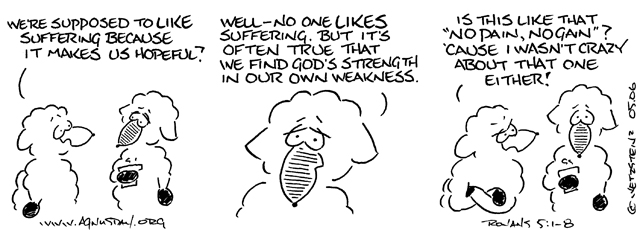
And frankly, Paul’s talk about how we “also boast in our sufferings” not only sounds just wrong to anyone who has ever known suffering, but also it is frankly the kind of passage that too often gets twisted into what one writer has called a “clobber verse,” the kind which those with more power or influence or status use to “clobber” those who Jesus might call “the least of these,” in this case by persuading them that their suffering is somehow the will of God when no, it isn’t. (This won't be the last time Paul says something that is easily twisted by people with axes to grind.)

The following sequence sometimes doesn’t help either, with its seeming suggestion that one has to suffer in order ever to get to hope – again, a way of clobbering the unfortunate or the suffering. “You have to suffer if you ever want to build character, or patience, or hope.” You see how it works? This is where it helps to remember Paul’s words from later in the letter.

You’ve probably heard it like this: “We know that all things work together for good for those who love God, for those who are called according to his purpose.” That’s over in Chapter 8. Even that can become a clobber verse until we remember that it is not about God wanting bad things to happen to us; it is that in all the things that happen to us, God is working for our good – not because of but despite the bad. In fact it might more accurately be translated "in all things God works for good for those who love God...". The point is that here in chapter 5, we don’t gain hope because we suffer; we gain hope because God works in us despite the suffering to lead us to endurance, to character, or to hope.

But not just any hope. I had a little bit of dialogue with a seminary classmate from those several years ago about this passage, and this subject of “hope” and just what kind of hope we’re talking about here. She was making the point that for us, far too often, hope (despite what Paul says in verse 5) really does disappoint us, or at least it sure seems like it.

And the thing is, she’s right. Hope does disappoint, most of the time.

We hope our loved ones will recover and continue to live among us, and they don’t. We hope the institutions of our society will seek justice instead of merely enforcing order, and our daily headlines make it clear they do not. We hope that we ourselves will truly live up to our best dreams, and we do not.

And Paul still says “hope does not disappoint.” And he’s still right too.

The question is, are you hoping for, or are you hoping in?

We know what it is to hope for – whether it’s the child hoping for a new bicycle for Christmas or me hoping for a clean result every time I go for a cancer screening, we hope for some thing, usually something fairly specific, something good or beneficial or at least not harmful. Sometimes our hopes are fulfilled – sometimes the child gets the bicycle, and my cancer screenings keep being clear so far – but painfully often we are disappointed. The new job doesn’t come, or turns out to be a horror show when it does. We send our child into the world and things don’t go well. Maybe they end up back home in disappointment. Our own health fails. 

When we hope for, inevitably we will be disappointed. Bodies fail us. Other people fail us.

But we hope in God. And that hope does not disappoint, because God does not disappoint.

God doesn’t promise us a bicycle or a perfect new job or perfect health. What God promises us is God, God’s own self, the love that is God. 

As Paul goes on to point out, we already know that love because God has shown us that love in dying for us – and dying for us when were weren’t even good people. That’s not how we’re accustomed to things working out, as Paul’s little meandering thought reminds us. Hollywood certainly wouldn’t show us a movie in which the hero dies for the villain. That’s just not how it works. And yet while we were still “sinners,” while we were still “ungodly,” while we were still “the baddies,” Christ died for us.

Verses 9-11 then wrap things up quite nicely with the reminder that we have been saved -- not only by Jesus's death but also by Jesus's life, and the only real reason we might "boast" (if we must) is in Jesus, the one in whom we are reconciled to God.

We know God’s love and God's hope, and those do not disappoint. When others around us disappoint and harm and murder and abuse and commit gross injustice, God’s hope does not disappoint. When our very world spins recklessly off its axis and the very fabric of our basic living together is trashed and torn by purveyors of hatred, God’s hope does not disappoint. 

In the reading from Matthew’s gospel just now (which I think you might hear more of next week), Jesus warned his disciples that his coming to them was no guarantee of peace; he did “not come to bring peace, but a sword” (Mt 10:34). But even when the sword has come, even when we are set child against parent, when we are beset by those who mockingly call us brothers and sisters … God’s hope does not disappoint.

We’re going to be in Romans for a while now, and I would encourage you to hold on to this point. It’s a book with some bleak lows and some incredible heartfelt highs. But whatever comes, whatever other arguments and meanderings and exaltations are to come, this is something to hold on: hope does not disappoint. Christ does not disappoint. God’s love does not disappoint, and that is where our hope – our only real hope – stands.  

And for that, Thanks be to God. Amen.


Hymns (from Glory to God: The Presbyterian Hymnal): #409, God is Here!; #353, My Hope Is Built on Nothing Less; #688, Spirit of God, Descend Upon My Heart


Credit: agnusday.org

Sunday, June 11, 2023

Sermon: The Promise Through Faith

First Presbyterian Church 

June 11, 2023, Pentecost 2A

Romans 4:13-25


The Promise Through Faith


It was slightly disorienting, upon first showing up in Independence (both back in March and again just a month ago), to see a number of signs, vanity plates on the fronts of cars, and other such displays, quite boldly displaying the word ROMANS typically in all caps. I wasn't really expecting to find the town being such a hotbed of interest in Paul's longest epistle (slighly longer than 1 Corinthians). I'll confess I was mildly disappointed to figure out that it was the name of an automotive dealership and a couple of other businesses in the area. 

Quite coincidentally, the Revised Common Lectionary offers up an extensive series of readings from this epistle to the churches at Rome for post-Pentecost study and preaching, and it's worth taking advantage of this opportunity. Because Paul is here writing to a church or group of churches he did not found and has not visited, and also because he's hopeful for some support for a planned journey to Spain (that never happened), this particular letter is much broader in scope than his other letters; those tend to dwell on specific matters in those churches, while here Paul is introducing himself by letter and being much more thorough about explaining his beliefs and actions to a community that only knows him by distant reputation. As a result, the letter is probably the most comprehensive exploration of Paul's message (or that of the early church) we have in scripture.

The Roman church (or again, perhaps more likely, a group of smaller churches in the city) is relatively typical in some ways of the other churches to which Paul writes; not large, diverse in interesting and sometimes provocative ways for its time, and made up of both Jewish and Gentile converts to following Jesus. That latter characteristic means that this group of followers is likely marked by the same disagreement Paul has run into more than once in his travels; the question of whether male Gentile converts should be compelled to undergo the Jewish practice of circumcision in order to be part of the church. Paul had come under attack in some quarters for his opposition to such a requirement, and likely as a result he begins this introductory letter to the Roman churches with an exposition on his view of this subject, a part of which is found in today's appointed reading. 

For Paul, that question comes down to how one is "put right with God," you might say, and Paul is quite insistent that it is all the work of God, not anything that humans can earn by any act or any law-keeping. Therefore, in verse 13 and after, Paul emphasizes that, through the grace of God, it was Abraham's faithfulness by which Abraham found favor with God. The first part of this chapter reminds readers that while Abraham was indeed circumcised, that did not happen until after the promise of God had come to him and he had accepted and believed in that promise. It wasn't the act of circumcision that made God look upon him favorably; it was his faithfulness in believing the promises God had made to him, for example, in today's reading from Genesis as well as later passages from that book.

That faithfulness of Abraham is further elaborated in verses 17 and after, as the experience of being promised a child to him and Sarah in their very old age became another example of holding faithful to God's promise despite all the evidence to the contrary, and that "that faith was reckoned to him as righteousness." Keeping the law (which, you'll remember, was still a few generations from being given on Mount Sinai) was not how Abraham was "put right with God." And if that was the case with Abraham, so also to the many "descendants" of Abraham now numbered among the faithful. 

All of this was not to denigrate the law, but to point out that it was not designed to make people faithful in the eyes of God; the law, by contrast, pointed out when those descendants of Abraham failed to be faithful. And at the last it does come down to Jesus, in case anyone was wondering; the Jesus whom God raised from the dead, who died in our trespasses and was raised up for our justification. 

What might often get overlooked in this passage is that first phrase of verse 15. After his plain statement of how "faith is null and the promise is void" if only adherents of the law are heirs of the promise to Abraham, he makes a rather bracing statement that "the law brings wrath." This looks frightening, to be sure, but in some ways it might be even more frightening than it looks.

Notice that statement again; "the law brings wrath." Notice what isn't there; any indication that we are talking about the wrath of God. It isn't the law brings God's wrath or the law brings down the wrath of God; just "the law brings wrath." So what exactly does that mean?

It's quite likely that Paul is speaking from experience here. In the epistle to the Philippians, chapter 3, Paul reminds those followers of his past: 


If anyone has reason to be confident in the flesh, I have more; circumcised on the eighth day, a member of the people of Israel, of the tribe of Benjamin, a Hebrew born of Hebrews; as to the law, a Pharisee; as to zeal, a persecutor of the church; as to righteousness under the law, blameless. 

(Philippians 3:4b-6, emphasis mine)


Here we are reminded of how we first met Paul; the one who minded the coats of those who stoned Stephen to death and approved of that act; who then set out on his own mission to round up and arrest or detain (or, if necessary, kill) those followers of Jesus, not only in Jerusalem but in Damascus as well. We also remember it was on his way to Damascus that Paul's quest was interrupted by the intervention of Jesus himself, in a blinding vision, and Paul ended up becoming one of those followers of Jesus himself.

When Paul says "the law brings wrath," again, it's hard to imagine his own past is not on his mind. He remembered how he had been trained in the law as a Pharisee, he remembered how he had so zealously kept the law to the point of being "blameless"; and he also remembered how that zeal for the law had turned him into a persecutor of the very church for which he now was an apostle of the faith. 

Perhaps it is a fortuitous circumstance that right now, depending on what streaming services you have available to you on your home television or computer, there are two interesting documentaries that might just point to this consequence of zealous adherence to the law. Currently available on Hulu is The Secrets of Hillsong, a four-part examination of the rise and spectacular fall of the leadership of Hillsong Church, the expansive and wildly popular megachurch operation started in Australia and spreading worldwide. A large part of the story is how those zealous leaders themselves went astray in marital infidelity and abusiveness against women; another part is how, despite its outward projection of welcome and acceptance, it turned out to be not that accepting of women, blacks, and other minority groups.

On the other hand, if you have Amazon Prime Video, you can stream Shiny Happy People: Duggar Family Secrets, about the family made famous by the various "18/19/21 and Counting" TV shows and the extreme theological teachings behind their organization. This comes, of course, after the arrest and conviction of one of the sons of that family for obtaining child pornography, and allegations that he abused others in the family. 

Something about that kind of zealous law-keeping seems to bring out the worst in us. Whether religious leaders or family leaders or frankly anyone caught up in it, it just seems inevitably to turn destructive, maybe even into wrath in Paul's words. It doesn't seem to bring life. It sure does seem to bring a zealous urge to persecute or take down those who don't keep that law exactly the same way you do. It brings wrath.

It is so important to understand that the promise God gives to us is not one we've earned. We don't "get right with God" by checking off rules on a list or by making any great display of our righteousness. And we certainly don't "get right with God" by checking off a set of beliefs that we will defend with great vigor and maybe a bit of wrath. We aren't justified by what we believe; we are justified by the one we believe in, the one we trust. All of that promise comes of God's doing, and our calling is to accept that grace and then to live that grace (not that law) to others. 

Yesterday marked the fortieth anniversary of the official act of reunification that created the Presbyterian Church (USA) of which we are a part. The years that have followed have seen struggles to fit those two bodies together that no doubt taxed the energies of many, and some churches and individuals have chosen to depart at various times over the four decades since reunion. PC(USA) is still here, though, and even that fact is a gift of the grace of God. That grace really does touch everything we are and do, and frankly the church of today will be a much more truthful and faithful witness to a frequently disinterested world when we remember that and remember to live as people of the promise through faith, through trust in the God who gives that faith and reckons that faith to us as righteousness, as that same God did for Abraham.

For the promise that comes through faith and through nothing else, Thanks be to God. Amen.


Hymns (from Glory to God: the Presbyterian Hymnal): #49, The God of Abraham Praise; #838, Standing on the Promises; #687, Our God, Our Help in Ages Past


No, not this Romans...

Sunday, June 4, 2023

Sermon: Accidental Heresies

First Presbyterian Church

June 4, 2023, Trinity A

Genesis 1:1-3, 26-312 Corinthians 13:11-13; Matthew 28:16-20


Accidental Heresies


If you've been wondering where the blessing I tend to use at the end of the service comes from, now you know. 

It shows up in today's lectionary scriptures for obvious reasons, but that doesn't change the fact that for preachers, Trinity Sunday is a field of landmines. 

As one of the few special Sundays on the liturgical calendar that takes a doctrine as its subject rather than an event in the church’s tradition, it can easily seduce a preacher into a futile attempt into explaining said doctrine. Not only is such sermon unlikely to be very successful at engaging hearers, but it also puts the preacher at risk for any of a multitude of errors that have, at some time in the church’s history, been denounced as heresies.

I’m not kidding.

If you saw my Facebook page this week, you might have noticed an odd little animated example of these pitfalls attached to the Trinity. In the cartoon St. Patrick attempts to explain the Trinity to a pair of supposedly simple Irish cousins (at their request) through a series of metaphors, only for those “simple” Irish country folk to shoot Patrick down with the name for the heresy expressed in the metaphor. Water appearing in three different forms – liquid, ice, vapor? Denounced as “modalism,” which was named as heresy at the council of Constantinople way back when. The three-leaf clover? A violation of the teaching that the three persons of the Trinity are of one substance, and are not distinct “parts” of God. This goes on until Patrick finally rants: 


All right, fine! The Trinity is a mystery that cannot be comprehended by human reason, but is understood only through faith, and is best confessed in the words of the Athanasian Creed, which states that we worship one God in Trinity, and Trinity in unity, neither confusing the persons nor dividing the substance; that we are compelled by the Christian truth to confess that each distinct person is God and Lord, and that the deity of the Father, the Son, and the Holy Spirit is one, equal in glory, co-equal in majesty!


To which those “simple” cousins respond, more or less, “well, why didn’t you say so?

Easy, right?

So no metaphors here. Accidental or not, I don’t need any heresies to deal with right now. Preaching is hard enough as it is.

But if it’s all that difficult, then what’s the possible benefit of having a whole Sunday devoted to this mysterious and seemingly inexplicable concept? Why have a Trinity Sunday at all if all it does is get preachers in trouble? (I realize for some people this is a good reason...)

I think there are a few reasons. 

I doubt this is a primary reason, but one of the great benefits of the doctrine of Trinity to the development of a real, humble, mindful spirituality is precisely that it is so incredibly difficult, if not impossible, to explain or to comprehend. We need to learn that there are things we aren't going to understand or comprehend, and the sooner we learn that, the better.

Today's reading demonstrates how any scripture (and there are a few) that seems to reference or gesture towards God as Trinity tends to do so almost in passing, not at all trying to explain the point but seemingly taking it as given. Even the reading from Genesis seems to have just a little bit of such talk; the "wind from God" in verse 3 somewhat sounds a little bit like the Holy Spirit, and notice how in verse 26 God says "Let us... in our own image...". While one might imagine it as some kind of divine "royal 'we'", it's at least suggestive choice of pronoun. And plenty of readers have bit on that suggestion and run with it, in most cases running too far for the evidence such a two-word phrase can provide.

Unfortunately, humanity has this terrible, destructive habit of taking very scant scriptural evidence and turning it (or trying to turn it) into hardened dogma to be used for judgment rather than instruction for the purpose of edifying the body of Christ. Even a few years ago, once when I was supposedly on vacation, I ended up in a conversation (on a different subject) in which I ended up being asked “so who am I supposed to say wrote it,” ("it" being one of the New Testament epistles of dubious authorship), to which I could only respond “you’re supposed to say you don’t know,” which is actually something Christians should probably say a lot more often than we do.

Today's scripture readings fit into that category pretty well. Much ink has beenn spilled using these readings to "prove" some arcane point about the doctrine of the Trinity that simply can't be sustained by Jesus's final words to his disciples or Paul's benediction to the Corinthians. The point is that these scriptures don't prove God as Trinity at all, but they take it as given.

It does cause one to wonder why think we will win the world to discipleship by logic and factual argument, or by having an airtight system in which no one can poke holes. No, that really isn’t how it works. The sooner we give up the idea that we’ve got God pegged, the better. Really, what kind of God would an easily explainable God be? We are called to live with mystery, folks, and the Trinity is one small but important corner of that mystery. 

Following on this, another possible value of the Trinity as a subject to consider is perhaps in its suggestion of community and togetherness even in the very nature of God; God is inherently in relationship. God is One, even as God is Three – Father, Son, Spirit in a relational sense and in the formula we usually speak in many churches, but we might also describe the Trinity as Creator, Redeemer, Sustainer, emphasizing ways that humanity has experienced God working in God’s world from creation to the redeeming act of the cross to the ongoing sustaining presence recognized in the form of a mighty wind and tongues as of fire at Pentecost. It’s possible we would be well served to widen our vocabulary for speaking of the Persons of the Trinity, rather than being tied down to a single exclusive formula that fails to teach us and bring us into a deeper experience of God as One and God as Three, an experience that might lead us to reconsider our own experience as community, as the body of Christ, as the recipients of the fruits of the Spirit, so that we understand ourselves much more as “we” and get less hung up on the “me”.

This last also points to something that is most useful about these scriptures offered for Trinity in the lectionary. As noted before, both the passages from Matthew and 2 Corinthians more or less seem to assume a three-in-one God even as they also put forth God as still one even as three, so to speak. Matthew’s record of Jesus’s parting words to his disciples places the now-familiar Trinitarian formula so regularly used at baptism – “in the name of the Father and of the Son and of the Holy Spirit” in the context of Jesus’s charge to the disciples to go – “go therefore and make disciples of all nations, baptizing them… .” While there’s a certain moment of pause when we, recognizing Jesus as Son of God, note that he’s evoking himself in this formula the way Matthew describes it, we don’t really think about it too much; it has simply become so commonplace that it is part of the sonic furniture of worship, so to speak, only examined more closely on an occasion like today.

Paul’s closing salutation, on the other hand, is born of a much more difficult situation. 2 Corinthians is a hard letter, written to a church that had brought great stress and humiliation upon Paul, and the letter consists a great deal of Paul letting them have it theologically. Nonetheless, as the letter comes to a close Paul chooses to use this salutation to remind them of what they have in common, the experience of God that binds them together to one another and also to the God they worship in common.  (It's worth noting that Paul's usual closing salutation only invokes one of those three elements.)

While we don’t want to get hung up on trying to make this into Trinitarian dogma – “grace must come only from Christ, love only from God, and what does communion even mean?” – we do want to take note of how such an evocative greeting points us again to how we are bound together in God. We are bound together with all the saints in the grace that brings us before God, the love that builds us up in God, and the communion or fellowship we share with one another in God. Paul points the Corinthians (and us) to the fact that while we have experienced God in these differing ways, they are all experiences of God. Three in one, one in three.

Maybe that’s the point here. To speak of this inexplicable mystery of a three-in-one, one-in-three God is perhaps to force ourselves to be sensitive to how we have experienced God. The unspeakable grace and mercy of a Savior who suffered so in redeeming us and restoring us to God; the unspeakable love of a Creator God whose providence is truly limitless; the unspeakable sustaining power of the Spirit that perhaps we don’t recognize until the end of a day we were absolutely convinced we would never get through, only to discover that somehow, we did. 

Even the sacrament we are about to take points to the Trinitarian work; the Redeemer calls us to the table, the bread and drink are given from God's creation, and the Spirit dwelling among us ministers to us in the sacrament. 

No analogies here, no set answers, no easy formulas. Today a preacher can only step away from the pulpit with mystery still fully in place, challenging you – challenging us – to be utterly confident in precisely what we can’t explain, in unending love and undying mercy and unexpected support that we can know as being from God even if we could never write a doctoral dissertation to prove we have conquered it. 

In the name of the Father and the Son and the Holy Spirit, the Creator and the Redeemer and the Sustainer, Three in One, One in Three, Thanks be to God. Amen.


Hymns (from Glory to God: The Presbyterian Hymnal): #2, Come, Thou Almighty King; #---, We Sing of God, Creator High; #1, Holy, Holy, Holy! Lord God Almighty


Clearly I failed to heed this advice...

Sunday, May 28, 2023

Sermon: All the Languages

First Presbyterian Church

May 28, 2023, Pentecost A

Numbers 11:24-30; Acts 2:1-21


All the Languages


One of the things that sometimes needs to be set straight about Pentecost is that no, this is not the first time the Holy Spirit is invoked in scripture. Today's first reading provides one such counterexample, as a stressed-out Moses pleads for help and God invokes that Spirit to be bestowed upon seventy elders of the people of Israel so that they might share some of the burden of leadership. That Spirit's appearance is made manifest in an outburst of frenetic prophesying, one that spills over to include two men back in the camp, not numbered among those seventy. Joshua (in a typical fit of church leadership) wants to have those two men silenced and that unexpected outburst of Holy Spirit squelched, but Moses (in a typical fit of pastoral weariness) stuffs that idea, crying out that he wished everyone could prophesy. It's not how we typically expect to see the Spirit play out, to be sure, especially since this prophetic outburst is only a one-time thing, but it still serves to remind us that the Holy Spirit is not a new thing as the disciples show up for this Pentecost morning.

While the Holy Spirit isn't new in this case, there are certainly some distinctive features of this particular Spirit-event that are worth noting on this one day of the liturgical year when the Spirit comes to the forefront. In last week's sermon I noted how the Ascension of Jesus got all of four words in the ancient creeds, and in one case the Holy Spirit doesn't do a lot better. The Apostles' Creed, one of the oldest statements of faith in Christendom, has this to say on the subject: 


I believe in the Holy Ghost...


That's it. Thankfully the Nicene Creed does a bit better, giving a whole paragraph to the subject. The church has some history of not really paying attention to this particular member of the Trinity, perhaps to its own harm; it is the Spirit most of all that is the most direct participant in the day-to-day life of the follower of Christ, and it is this Pentecost in-breaking of the Spirit that marks the ongoing truth of this presence and participation.

Since we last heard from this group, we know that they have indeed remained in Jerusalem as they were instructed. Acts also mentions in an interesting aside that they elected one of their number to replace Judas, the traitor against Jesus whose grisly death is reported in an aside. And they have waited, probably wondering what exactly they were waiting for. Now they're about to find out.

The description itself lingers: "a sound like the rush of a violent wind"; "divided tongues, as of fire"; and then, the sound of all the languages.

Let's be clear; this group of followers is speaking languages they don't know, but that other peoples outside of Judea or Palestine do speak. Ecstatic utterances in tongues that require interpretation (what we commonly call "speaking in tongues") come later in Acts; this event is one of miraculous speech and hearing.

Those tongues matter because just outside their windows there is a crowd of folks gathered in Jerusalem for the festival of the harvest that was Pentecost in the Jewish tradition, a group ripe to hear something good each in their own language.

Have you had that experience of being in a crowd with people speaking any language but your own? The particular challenge of this was pressed home for me many years ago when I was in Quebec City for a conference back in my academic days. The conference itself was held in English but going out for dinner or frankly anything else meant being among French speakers. While some also spoke English well enough to understand me, that wasn't always the case. I'm horrible with languages, and French is one of my worst. At least in this case the worst that came to me was that I declined the sugar I very much wanted for my coffee. 

These people were Jews from, as a Judean would have seen it, all over the world. The list of locations provided here literally denotes a whole range of nationalities from the east, north, west, and south of Jerusalem, a way of evoking that which we sometimes metaphorically call "the four corners" of the world. Before these followers of Jesus get sent out into the world, the world has come to them. And because of this outburst of the Holy Spirit, the world at the windows is able to hear good news, each in their own language.

This is not always a thing the church or the world has taken to heart. The Western world in particular has a particular imperial history of forcing their own languages upon those peoples whom they encounter, or frequently whom they conquer. On the North American frontier, those seeking to drive out or subjugate the Native peoples made a very specific and fixed point of pushing to  eradicate the languages those so-called "savages" spoke. An Indian, in the vernacular of the time, could only be tolerated if every trace of "Indian-ness" was driven out of them, and it was presumed that one of the surest ways to do so was to take away their language, especially in the "Indian" schools that appeared on those frontiers (one of which was just up the way in Lawrence, since changed into Haskell Indian Nations University). The students at such schools were forbidden to speak their own language, being forced to speak English, or possibly French in Canadian schools. This, of course, was in addition to numerous other oppressions visited upon them, quite literally as a means of separating them from their families and their peoples for good.

What happens in today's scripture is the complete and total opposite of that act of emotional violence. Those seekers who came to Jerusalem, thanks to the working of the Holy Spirit, were welcomed in their own languages. They weren't stripped of who they were, weren't denied their own humanity and worth, in order to hear the gospel. One could even say that this Holy Spirit outbreak was for these listeners, the ones who heard the commotion of that sound like a violent wind and wondered what was going on, as much as it was for these followers of Jesus, or maybe even more so. 

We don't really know how it worked from here forward, as the believers (including possibly those who became believers on this day) were scattered from Jerusalem into, well, all the world. There were certainly going to be language barriers to be faced as these followers of Christ spread further and further out from Judea. But these followers knew from experience that the Holy Spirit would find a way for them to communicate with those waiting to hear the gospel. 

Do we have that same confidence? Does the church today, which can struggle with getting a worship service posted onto Facebook or YouTube, have the confidence to find a way into a world of Instagram or TikTok or whatever social media outlet comes next, outlets where exactly the folks who don't darken the doors of the church find a kind of media "home"?

On the flip side, it can be a scary thing to find ourselves in a world where, more and more, it seems like most folks out there aren't speaking our "language," whether literally or more figuratively. While Pentecost can mean an awful lot of different things in the life of the church, sometimes it can be hard to remember that the Holy Spirit has experience with helping Christ's followers find the right language to speak, if we will listen and submit to that work. It might be disruptive, and it might take us out of our comfort zones, but it has been done, and it can be done. 

At the same time, the Holy Spirit also has that experience of preparing those who listen, those who seek to hear, those who call upon the name of the Lord, to be able to hear that word in their own language and to be ready to respond. 

For all the languages, and the Spirit's ability to speak them, Thanks be to God. Amen.


Hymns (from Glory to God: The Presbyterian Hymnal): #289, On Pentecost They Gathered; #292, As the Wind Song; #66, Every Time I Feel the Spirit